Gračanica Monastery
ninaniki | 11 Jun, 2016 22:15
Gracanica Monastery one of King Milutin's last monumental endowments. It is situated in the village of Gracanica, 5 km from Pristina, the administrative centre of Kosovo and Metohija region. Gracanica was constructed on the ruins of an older 13th-century church of the Theotokos, which was built on the ruins of a 6th-century early Christian three-naved basilica.
The architectural composition of Gracanica represents the peak of Serbian architecture in the spirit of Byzantine tradition. Unfortunately the rich Gracanica treasury was lost in fires between 1379 and 1383. The present treasury stores a number of valuable icons from the 16th, 17th and 18th centuries, as well as several significant manuscripts and liturgical objects.
After the Second World War it was renewed by nuns and has been serving as a convent since. Today there are 24 sisters in the monastery who are active in icon painting, agriculture, sewing and other monastic obediences.
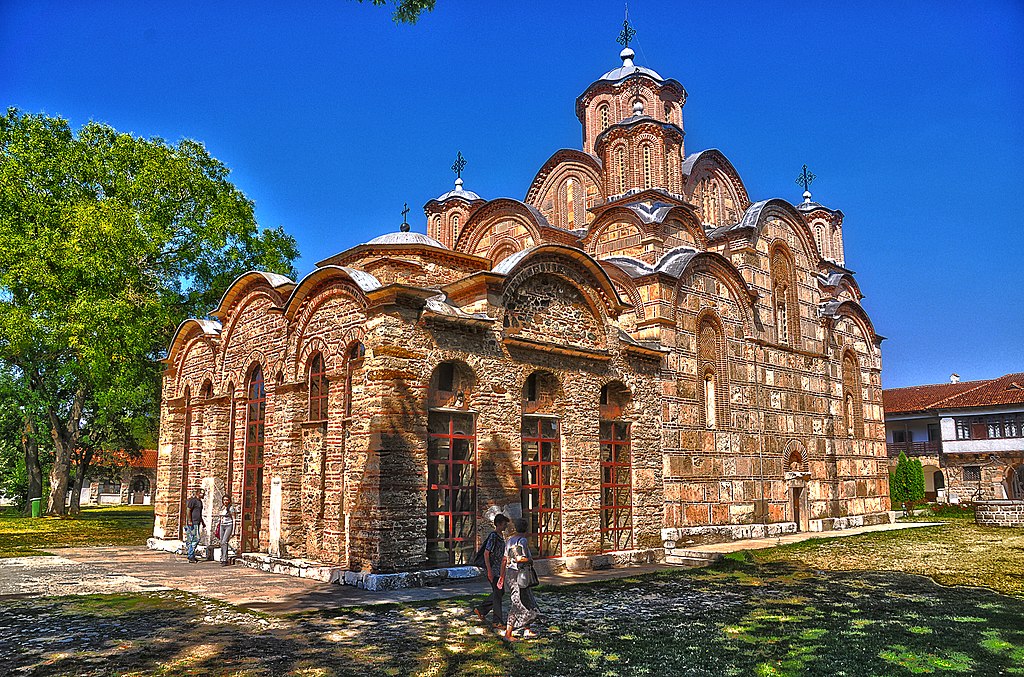
The frescoes of Gračanica Monastery were painted in 1321-22 and have been well-preserved. In the Gračanica Monastery church three kinds of painting can be discerned. The earliest Gračanica Monastery frescoes are found in the nave, that are the work of the so called “King Milutin’s court school” whose achievements belong to the best trends of the classical art in the period of the Paleologues, whereas two later ones can be recognized in the narthex. The focal paintings of Gracanica include the Festival Cycle, the Passion and the miracles of Christ. Inside the narthex, there are portraits of the founders: King Milutin and Queen Symonis, Queen Helen d’Anjou (king’s mother) as a nun and King Milutin as a monk. Of particular importance is the Nemanjich dynasty genealogy, the first ever painted, which starts with Stefan Nemanja and ends with Milutin.
Gračanica Monastery is inscribed on the List of UNESCO World Heritage in Danger. Various cultural events of great significance for the Serb population of this part of Kosovo and Metohija are held in Gracanica Monastery.
Posted in
Generalna .
Dodaj komentar: (0).
Trekbekovi:(0).
Permalink
Ćelije Monastery
ninaniki | 11 Jun, 2016 21:53
The Ćelije Monastery is a Serbian Orthodox monastery. It is located by the Gradac river, from the town of Valjevo. It was founded in the late 13th century. Today, monastery is surrounded with tall trees, so cannot be seen from far.
The monastery probably owes its name to the numerous monks’ cells that can be seen in the rocky caves of the nearby cliffs.
Apart from the main church, in the monastery yard you can see an interesting charnel. It holds the bones of the numerous anonymous people found in the monastery grounds by nuns when they single-handedly rebuilt the monastery after WWII.
Celije Monastery has a beautiful yard, with a lot of fir trees, flower beds and lawns. Dormitory building is made of red brick and white stone in a very unusual architectural style.
It is not known who built the monastery, nor when. The monastery is believed to have been founded by Serbian king Dragutin, who reigned this area from 1282 to 1316.

A local legend has it that three brothers of the Nemanjic royal dynasty built three monasteries in this area: Celije, Jovanje and Pustinja. However, the monastery was most likely founded during the reign of Despot Stefan Lazarevic(1389-1427) in the times of social and religious revival of Western Serbia. At the time, the town of Valjevo was the residence of the metropolitan bishop, while the main church was in the Celije Monastery.
Ćelije Monastery was declared Monument of Culture of Great Importance in 1979, and it is protected by Republic of Serbia.
Posted in
Generalna .
Dodaj komentar: (2).
Trekbekovi:(0).
Permalink
Manasija Monastery
ninaniki | 11 Jun, 2016 21:35
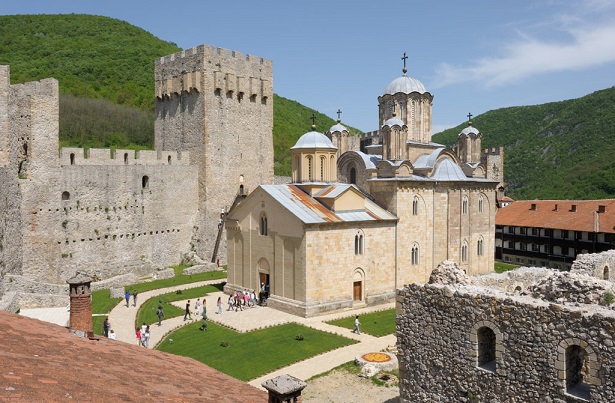
Manasija, also known as Resava, is a Serb Orthodox monastery near Despotovac, founded by Despot Stefan Lazarević between 1406 and 1418. The church is dedicated to the Holy Trinity. It is one of the most significant monuments of medieval Serbian culture and belongs to the "Morava school". The monastery is surrounded by massive walls and towers.
The Monastery of Manasija stands protected by the massive walls with eleven towers and trenches. In spite of its importance Manasija Monastery was severely attacked and damaged several times by Turks. The complex of Manasija Monastery was looted and burnt in 1456 so it is served more as a fort than a place of worship.
Built in tumultuous times, the monastery is fortified by strong ramparts and towers. Huge fortress that surrounds the monastery has an irregular polygonal basis. There are 11 towers, the most beautiful one being Despot's Tower, on the north side.
Inside the fortress, apart from the main church, there is also the dormitory building as well as the monastery dining room. The church is devoted to Holy Trinity.
The frescoes have been only partially preserved, but what can be seen today is considered to be among the best works of Serbian medieval art. One of the most famous frescoes is the portrait of Despot Stefan Lazarević. Inside the front door arch is a fresco representing. The Souls of the Righteous in Divine Hand.
Fresco Holy Wariors is considered to be one of the most beautiful frescoes in all Serbia churches, especially valuable for the fact that it shows typical clothing and weapons from the 15th century Serbia.
Manasija complex was declared Monument of Culture of Exceptional Importance in 1979, and it is protected by Republic of Serbia.
Posted in
Generalna .
Dodaj komentar: (139).
Trekbekovi:(0).
Permalink
Krušedol Monastery
ninaniki | 11 Jun, 2016 20:38
The Krušedol monastery is a Serb Orthodox monastery on the Fruška Gora mountain in the northern Serbia, in the province of Vojvodina. The monastery is the legacy of the last Serbian despot family of Srem - Branković. It was built between 1509 and 1514. It is shown on the 5 Dinar coin.
The Krušedol monastery church is dedicated to the Annuciation of the Holy Virgin, built mostly in the Morava architectural style. The Krušedol church has been later renewed in baroque style, early 18th century, when the high, five-store bell tower was added. The Krušedol Monastery was heavily destroyed and set a flame by Turks in 1716 during their retreat in the last attacks to the Austria-Hungary territories.
The most precious among the historical values of Krušedol Monastery is the iconostasis which among 36 icons comprises an icon dating from the 15th century.
Nowadays Krušedol Monastery is the Mausoleum of numerous significant historical persons. Krušedol Monastery possess rich collection of old precious icons, manuscripts and printed books. The feast day of Krušedol Monastery is celebrated on the day of the most Holy Mother Angelina of Serbia, on the 12th - 30th of August.
Krušedol monastery was declared a Monument of Culture of Exceptional Importance in 1990 and it is protected by the Serbian state.
Posted in
Generalna .
Dodaj komentar: (1).
Trekbekovi:(0).
Permalink
Monastery Ravanica
ninaniki | 11 Jun, 2016 15:13
Ravanica is a Serbian Orthodox monastery on Kučaj mountains near Ćuprija in central Serbia. It was built in 1375-1977 as an endowment of prince Lazar of Serbia, who is buried there. The Ravanica church is called the birthplace of the new artistic movement "Morava school" because of architectural and artistic features. It is original blend of the Mount Athos and the cross-in-square five-domed model that became standard in the time of King Milutin.
Ravanica monastery was the largest, most important foundation by king Lazar Hrebeljanović. It was described in the famous folk poem "Building Ravanica". The poem says that queen Milica talked her husband, king Lazar, into constructing a monastery for the salvation of his soul, after the example of ancient Serbian royal dinasty Nemanjić.
Ravanica was declared Monument of Culture of Exceptional Importance in 1979, and it is protected by Republic of Serbia.
Posted in
Generalna .
Dodaj komentar: (0).
Trekbekovi:(0).
Permalink
Mileševa monastery
ninaniki | 11 Jun, 2016 14:35
Mileševa is a Serbian Orthodox monastery located near Prijepolje, in southwest Serbia. It was founded by King Vladislav, in the years between 1234 and 1236. The church has frescoes by the most skillful artists of that time, including one of the most famous in Serbian culture, the "White Angel", which depicts an angel on Christ's grave. White Angel is a detail of one of the best known frescoes in Serbian culture in the Mileševa monastery. Considered one of the most beautiful works of Serbian and Europian art from the High Middle Ages, this fresco is considered to be one of the great achievements in Europian painting. In the 16th century, the White Angel was over-painted with another fresco, and so was hidden until the 20th century when the fresco was restored. A picture of the White Angel of Mileševa was sent as a message from Europe to America, as a symbol of peace and civilization.

At the earlier royal foundations, monasteries, the church of Mileševa was built in the style of Raška. This style was characterized by the Romanesque type of building. Because of the tomb of St. Sava, Mileševa acquired enormous prestige in the eyes of the Serbian nation, becoming a center of pilgrimage, while under the Turkish rule it was a source of hope and courage for the enslaved people. In order to suppress the spiritual ascendancy of St. Sava the Turks away his relics from the Monastery of Mileševa and burnt it on the state of Vračar in Belgrade.
Mileševa was declared Monument of Culture of Exceptional Importance in 1979, and it is protected by Republic of Serbia.
Posted in
Generalna .
Dodaj komentar: (0).
Trekbekovi:(0).
Permalink
Monastery Sopoćani
ninaniki | 11 Jun, 2016 13:39
The Sopoćani monastery, an endowment of King Stefan Uroš I of Serbia, was built from 1259 to 1270, near the source of the Raška River in the region of Ras, the centre of the Serbian medieval state. It is a designated World Heritage Site, added in 1979.

The monastery church is dedicated to the Holy Trinity. In the middle ages it was a thriving monastery with more than a hundred monics. The monastic compound is still encircled by a thick wall. The church also served as a royal mausoleum. After the battle of Kosovo, Sopoćani monastery was burned by Turks. Even the church was seriously damaged. Reconstruction ensued in the 15th century and by the end of the 16th century and the the beginnig of the 17th century monastic life in Sopoćani was flourishing again. In 1689 Turks burned the monastery once again and it remained deserted until the 1960s. After a period of 30 years when the monastery served as a convent it was renewed in 1996 by Bishop Artemy who brought a young brotherhood to Sopoćani. This new brotherhood is now actively working on reconstruction and the spiritual rebirth of this important medieval shrine.
The frescoes in the Sopoćani Monastery church, dating from 1270-1276, are among the finest in Byzantine and Serbian medieval art. These exceptional paintings represent the work of the best artist of that period who were unable to work in the territory of the Byzantine Empire and found refuge of the court of the Serbian king. At Sopoćani these artits introduced a refined spirit of antiquity to the prevailing medieval conventions.
During 20th century monastery is renewed and today is settled by numerous and very active brotherhood of monks. The fact that most of Sopoćani frescoes many consider as a miracle. The beauty presented in this archive survived more than 2 centuries of extreme metheorological circumstances and despite that conserved all of its glory.
Posted in
Generalna .
Dodaj komentar: (0).
Trekbekovi:(0).
Permalink
Monastery Visoki Dečani
ninaniki | 11 Jun, 2016 12:02
Visoki Dečani Monastery is a major Serbian Orthodox monastery, situated in Kosovo and Metohija. It was built between 1327 and 1335 by the Serbian medieval king St. Stephen of Dečani and was dedicated to the Ascension of the Lord. The monastery is settled in the picturesque valley of the Bistrica river surrounded by the mountains and forests of the Prokletije mountain range.
It is the largest and best preserved medieval monastery in Serbia. During its turbulent history the Monastery was an important spiritual centre with developed artistic and intellectual activities. Although the monastery buildings suffered damage from the Turkish occupation, the church has been completely preserved with beautiful 14th century fresco paintings.
In 2004, UNESCO listed the monastery on the World Heritage List, citing its frescoes as "pn of the most valued examples of the so-called Palaeologan renaissance in Byzantine painting" and "a valuable record of the life in the 14th century".
Today a young brotherhood of 30 brethern lives in the monastery continuing the centuries old tradition of the past. The brotherhood has developed various activities: wood carving, icon painting, book publishing and is also active in the missionary work.
Posted in
Generalna .
Dodaj komentar: (0).
Trekbekovi:(0).
Permalink
Monastery Studenica
ninaniki | 11 Jun, 2016 11:41
The Studenica monastery is a 12th-century Serbian Orthodox monastery near Kraljevo. It is one of the largest and richest Serb Orthodox monasteries. Stefan Nemanja founded the monastery in 1190. The monastery's fortified walls encompass two churches: the Church of the Virgin and the Church of the King, both of which were built using white marble. The monastery is best known for its collection of 13th and 14th century Byzantine style fresco paintings.

Studenica was declared Monument of Culture of Exceptional Importance in 1979, and it is protected by Republic of Serbia, and in 1986 UNESCO included Studenica monastery on the list of World Heritage Sites.
The monastery Studenica, dedicated to the Presentation of the Holy Virgin, is the mother church of all Serbian temples. It was constructed over a quite long period of time. The complex of Studenica monastery includes the Church of St. Nicholas. Between the Church of St. Nicholas and the King's Church are the foundations of the church dedicated to St. John the Baptist. On the western side of the monastery complex there is a bell tower, erected in the 13th century.

Posted in
Generalna .
Dodaj komentar: (0).
Trekbekovi:(0).
Permalink
Monastery Žiča
ninaniki | 05 Jun, 2016 19:12
Žiča is an early 13th-century Serb Orthodox monastery near Kraljevo. The monastery was burned in a raid near the end of the 13th century and was deserted. Žiča suffered damage during World War II and after the war Žiča became a woman's monastery. The monastery, together with the Church of the Holy Dormition, was built by the first King of the Serbia, Stefan the First-Crowned and the first head of the Serbian Church, Saint Sava.
Žiča was the seat of the Archbishop, and by tradition the coronational church of the Serbian kings, although a king could be crowned in any Serbian church, he was never considered a true king until he was anointed in Žiča.
Žiča was declared a Cultural Monument of Exceptional Importance in 1979, and it is protected by Serbia. In 2008, Žiča celebrated 800 years of existence. It was founded by King Stefan the first - crowned and Saint Sava, in 1207 or shortly thereafter. It was built with help of Greek masters. The red color of the exterior walls is a symbol of the blood of the martyrs of the early Christian church.
Posted in
Generalna .
Dodaj komentar: (2).
Trekbekovi:(0).
Permalink